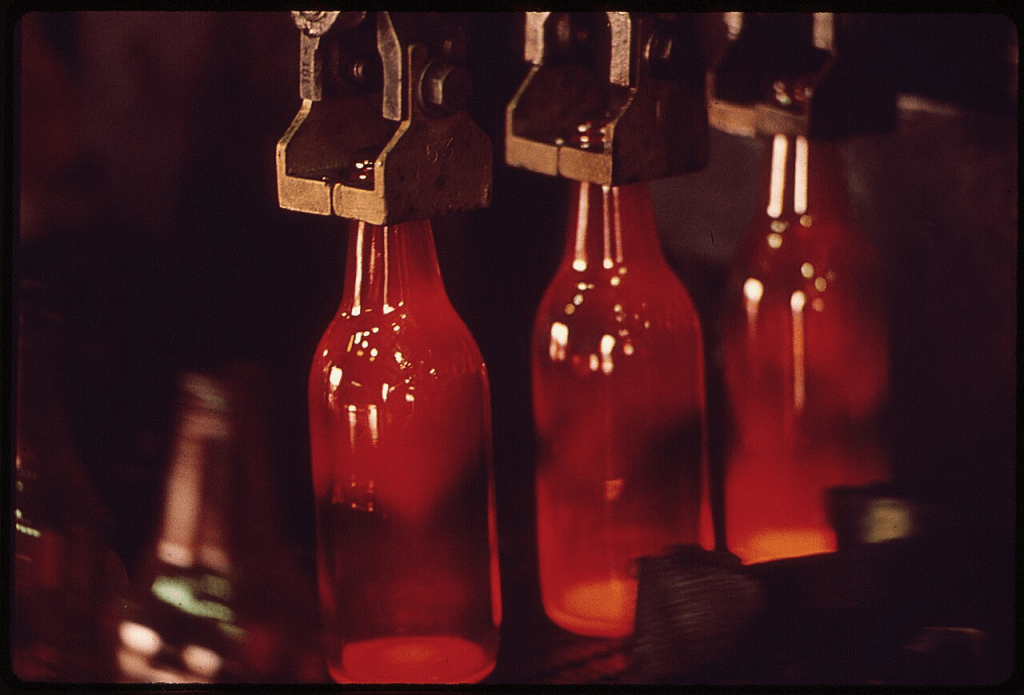
How are glasses and glass bottles manufactured?
- The behaviour of glass at different temperatures is critical. Glass has a broad range of temperatures over which it retains its shape but can still be moulded.
- Raw ingredients are melted in a furnace at up to 1570C. Modern glass furnaces are typically electric, using molybdenum electrodes (somewhat lower melting point than tungsten, but much cheaper).
- The glass is cut into “gobs” of the right weight (temperature 1050C to 1200C).
- This diagram shows the rest of the process:
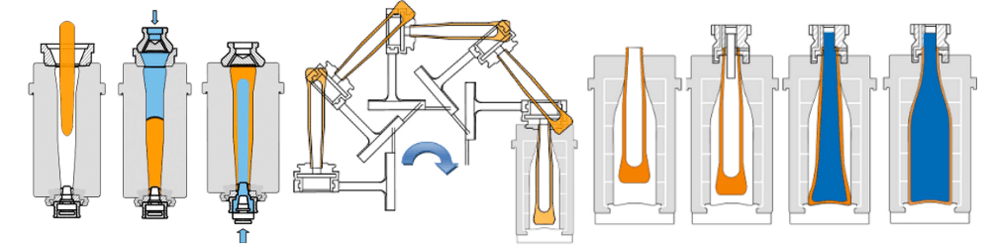
- The first step makes a hollow container (“parison”), smaller in size than the final product. This is done using compressed air (in the “blow and blow” process) or a metal plunger (in the “press and blow” process).
- The container is then blown out into the final mould using more compressed air. Thinner parts cool faster, meaning they don’t expand as quickly due to their viscosity. This prevents these regions from blowing out.
- Annealing is carried out (several hours at 370C to 480C) to reduce internal stresses.
- A very thin two-layer coating is applied (tin oxide + polyethylene wax) to make the surface slippery. This is to make the glass much harder to scratch (a cutting edge just slides off).
 Joe Pater's Website