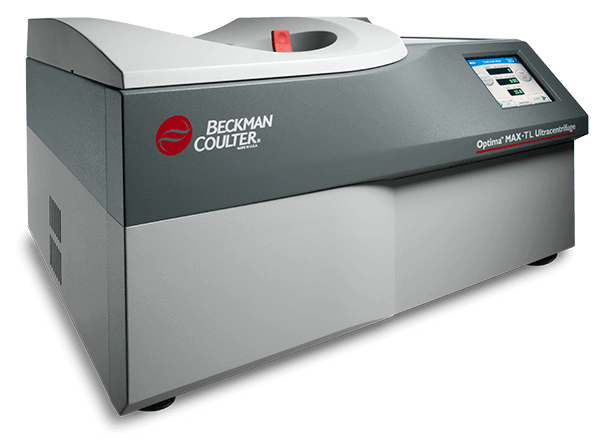
These are two of the fastest spinning machines in the world.
- An ultracentrifuge is a centrifuge with centripetal acceleration going beyond 105 g, with modern models going to around 106 g. At this upper speed, a 1 g mass will appear like 1000 kg!
- Early ultracentrifuges operated using compressed jets of air spinning the rotor in a vacuum. Modern models use electric motors to achieve speeds of 150,000 rpm.
- Dental drills spin at even higher speeds: 400,000 rpm is typical, although some can reach 800,000 rpm.
- These drills use a miniature air turbine in the rotor. Electric models do exist but are a bit slower. The drill tip is typically water cooled due to the heat generated from friction.
- Despite the higher speed, the centripetal acceleration is lower than the fastest ultracentrifuge: assuming a 1 mm tip radius, it would be 180,000 g for 400,000 rpm and 720,000 g for 800,000 rpm.
- In both of these machines, material choice is very important. Since masses are multiplied by a factor of 106, the important parameter is strength to weight ratio, as well as friction coefficient and heat resistance. Some recent centrifuge rotors are made of carbon fibre. Meanwhile the bearings used in dental drills use ceramics.
 Joe Pater's Website